
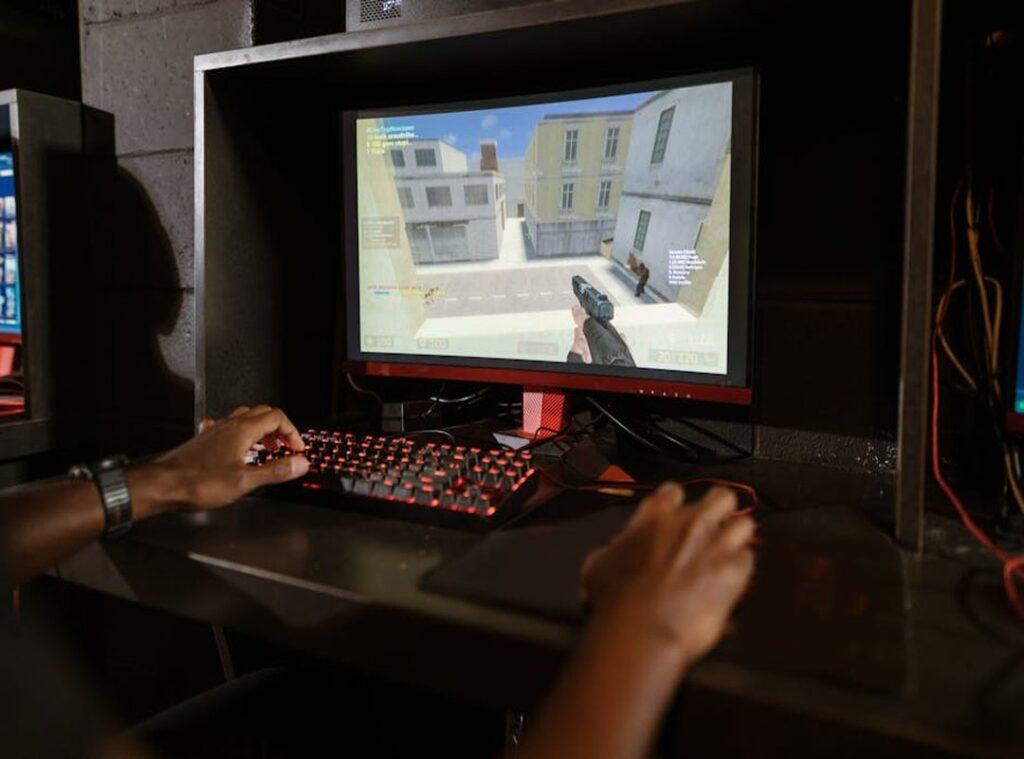
You miss the smell of popcorn and sweat. The clatter of quarters hitting metal. That buzz when someone finally beats your high score on Street Fighter.
I do too.
But let’s be real. Arcades didn’t just shrink. They vanished.
Replaced by solo play, silent headsets, and games that treat you like a number in a database.
What’s left feels lonely. Not fun.
Enter the First Person Online Hstatsarcade. Not a game. Not a platform.
A place.
I’ve spent over 200 hours inside these spaces. Watched strangers become teammates. Seen rivalries spark over ping-pong physics.
Felt that old arcade energy (but) online.
This isn’t a list of games to try.
It’s how to find and feel that energy again.
You’ll learn what makes these spaces work.
And why most people walk right past them.
First Person Online Gaming Arcades: Not Just Another Launcher
I’ve used Steam since 2008. I’ve played Fortnite in squads. Neither made me feel like I walked into a neon-lit carnival at midnight.
That’s what a First Person Online Hstatsarcade does.
It’s not a menu. It’s not a lobby. It’s a virtual theme park you step into.
Head first, controller in hand, avatar moving with you.
Hstatsarcade is one of the few that nails this.
You’re not selecting games from a list. You’re turning a corner and spotting a pixel-art air hockey table glowing under a sign. You walk up.
You play. Someone waves from across the plaza. You wave back.
That shared 3D space? It’s the foundation. No loading screens between games.
No alt-tabbing out of your own immersion.
The games inside aren’t massive RPGs. They’re arcade-style (quick,) tactile, replayable. Think skee-ball with physics, or a rhythm shooter where the targets pulse to bass drops.
And yes. Proximity chat matters. If you stand next to someone, you hear them.
If you walk away, it fades. No UI pop-ups. Just sound.
Like real life (sort of).
First-person isn’t a gimmick here. It’s the difference between watching a party and being at one.
Steam sells games. Fortnite hosts matches. A true online arcade hosts people.
You don’t launch it. You enter it.
Does that sound like what you actually want to do with your free time?
Most platforms treat players like accounts. This treats you like a person who showed up.
Try it. Then tell me you still want to click “Play” on a flat grid.
Online Arcades Worth Your Time (Not Just Clickbait)
I’ve tried more than a dozen. Most crash, lag, or feel like someone’s basement project.
These three actually hold up.
First Person Online Hstatsarcade is one of them. But it’s not the only one worth your attention.
Let’s start with RetroGrid. It’s pure neon-drenched nostalgia. Think Tron meets 1987 arcade cabinets.
You drop into a grid-based city hub where every door opens a game. Two standouts: Zombie Shift, a co-op wave shooter where you and three friends barricade a diner while zombies bounce off physics objects (yes, they get stuck in ceiling fans), and Pinball Bowling, a competitive spin on bowling where gravity shifts mid-roll and your ball curves like it’s got opinions.
Its social draw? Voice chat baked into every lobby. No Discord required.
You hear people laugh when their ball flies into orbit.
It’s free-to-play. Grab it on Steam.
Next up: NexusVR. This one’s built for headsets first. No flat-screen afterthoughts.
The vibe? Like stepping into a sci-fi modding convention. Everything feels user-made, slightly janky, and wildly inventive.
Try Gravity Forge, where you design weapons by welding parts mid-orbit, then test them in zero-G duels. Or Echo Rooms, a puzzle game where you record your own movements and layer them like ghost clones to solve timed mazes.
What makes it different? You can upload your own games. Not just skins or maps.
Full games. I’ve seen a working chess variant that uses black holes as pieces.
It’s $25. Oculus Store only.
Then there’s Lagoon. Calm. Quiet.
No sirens. No leaderboards.
You spawn on a floating island with palm trees, a tiki bar, and a mini-golf course that wraps around a waterfall. Hit the ball wrong and it vanishes into mist (no) penalty, no stress.
Their movie theater runs real indie films (not) trailers. You sit with strangers, but nobody talks unless you tap their shoulder.
No microtransactions. No ads. One-time $12 purchase.
Available on Steam and itch.io.
I’m not sure if any of these will last five years. The tech shifts fast.
But right now? They work. They’re fun.
And they don’t make you feel like a data point.
It’s Not Just About High Scores: The Social Element

I used to think online games were about winning. Then I spent six months in First Person Online Hstatsarcade servers where nobody even checked the scoreboard.
That’s when it clicked: this isn’t a competition. It’s a hangout.
You can read more about this in Multiplayer Guide.
You wait in the lobby with five strangers. Someone cracks a joke. Another shares their weird avatar dance.
You’re not teammates yet. But you’re already talking like you’ve known each other for years.
That’s what “third place” means. Not home. Not work.
Just there. Relaxed, no pressure, no performance review hanging over your head.
I’ve seen people meet at 2 a.m., challenge each other to a silly duel mid-convo, or rally the whole server for a surprise fireworks event. Voice chat makes it real. Expressive avatars make it human.
Text chat feels like shouting into a tunnel by comparison.
The social layer isn’t an add-on. It’s the reason people stay.
Want proof? Try it yourself. The Multiplayer Guide Hstatsarcade shows exactly how to jump in without feeling lost.
No tutorials needed. Just show up. Talk.
Laugh. Leave with three new friends.
That’s how it works.
Your First Virtual Arcade Visit: Don’t Just Click and Pray
I walked into my first virtual arcade blind. Got lost in the hub for twelve minutes. Found a secret door behind a soda machine.
(Yes, really.)
Explore the hub world first. Not later. Not after you’ve already rage-quit Cyber Dodgeball.
Tap random walls.
Walk every path. Look up. Look down.
Say hello to someone. Use voice chat. It’s not weird.
It’s how you find your people. Or at least your next co-op partner.
Try games that aren’t trending. That pixel-art fishing sim? Yeah, it’s slow.
But it has weekly lore drops no one talks about.
Check daily events. Not for the rewards (though) some are solid. But for the rhythm.
You’ll learn when the real action starts.
This isn’t just about playing. It’s about presence.
And if you’re coming from Hearthstats? Grab the Hstatsarcade Mobile From before you go. Makes the transition smoother.
First Person Online Hstatsarcade? Start here. Not anywhere else.
Grab Your Virtual Tokens and Start Playing
I know what you’re after. Not another lonely lobby. Not another clone with chat turned off by default.
You want real people. Real reactions. Real surprise.
First Person Online Hstatsarcade fixes that. It’s not retro for the sake of filters. It’s social tech built into the controls.
You laugh with someone (not) just at their kill feed.
Remember finding a new cabinet as a kid? That buzz when the screen lit up and someone leaned in? It’s still there.
Just faster. Just louder. Just shared.
You’ve scrolled long enough. Your friends are waiting. The tokens are loaded.
Pick one of the arcades we covered. Invite a friend. Dive in.
The digital prize counter is waiting.
 Ask David Kaplantopherr how they got into latest gaming news and you'll probably get a longer answer than you expected. The short version: David started doing it, got genuinely hooked, and at some point realized they had accumulated enough hard-won knowledge that it would be a waste not to share it. So they started writing.
What makes David worth reading is that they skips the obvious stuff. Nobody needs another surface-level take on Latest Gaming News, Player Strategy Guides, Expert Commentary. What readers actually want is the nuance — the part that only becomes clear after you've made a few mistakes and figured out why. That's the territory David operates in. The writing is direct, occasionally blunt, and always built around what's actually true rather than what sounds good in an article. They has little patience for filler, which means they's pieces tend to be denser with real information than the average post on the same subject.
David doesn't write to impress anyone. They writes because they has things to say that they genuinely thinks people should hear. That motivation — basic as it sounds — produces something noticeably different from content written for clicks or word count. Readers pick up on it. The comments on David's work tend to reflect that.
Ask David Kaplantopherr how they got into latest gaming news and you'll probably get a longer answer than you expected. The short version: David started doing it, got genuinely hooked, and at some point realized they had accumulated enough hard-won knowledge that it would be a waste not to share it. So they started writing.
What makes David worth reading is that they skips the obvious stuff. Nobody needs another surface-level take on Latest Gaming News, Player Strategy Guides, Expert Commentary. What readers actually want is the nuance — the part that only becomes clear after you've made a few mistakes and figured out why. That's the territory David operates in. The writing is direct, occasionally blunt, and always built around what's actually true rather than what sounds good in an article. They has little patience for filler, which means they's pieces tend to be denser with real information than the average post on the same subject.
David doesn't write to impress anyone. They writes because they has things to say that they genuinely thinks people should hear. That motivation — basic as it sounds — produces something noticeably different from content written for clicks or word count. Readers pick up on it. The comments on David's work tend to reflect that.